
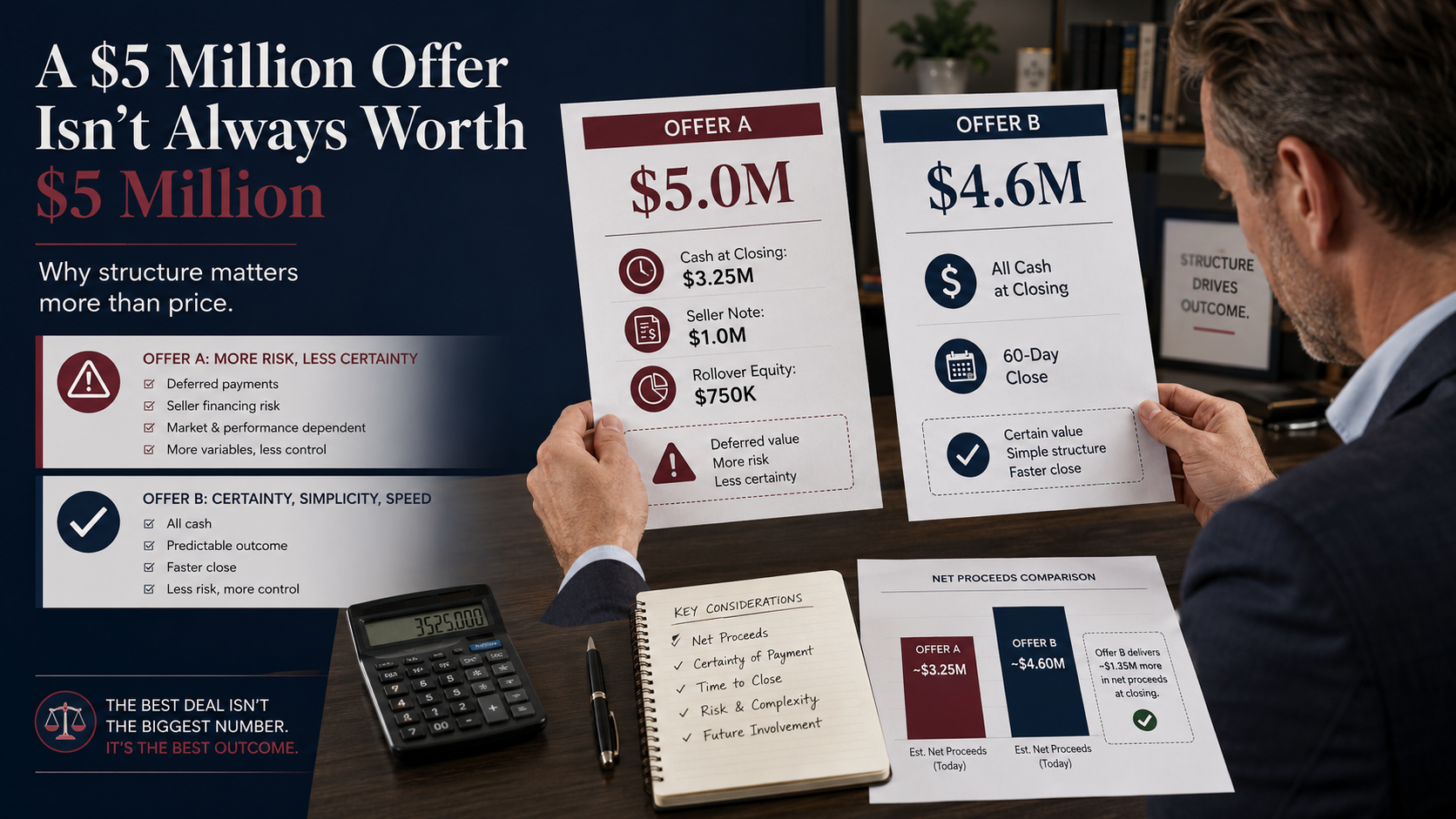
A $5 Million Offer Isn’t Always Worth $5 Million
As your broker, the first thing I need to know isn’t your asking price. It’s what you need at the end of the day — the number you actually walk away with once everything settles.
Because here’s what I’ve learned watching offers cross my desk: price is almost never the thing we base the decision on. The structure is. Two offers with the very same headline number can differ by hundreds of thousands of dollars in real, after-tax, in-your-pocket proceeds — and the bigger number on top isn’t always the better deal.
Ask an owner what their company sold for and you’ll get one clean figure. Ask what they kept — after the debt payoff, the taxes, the working capital adjustment, and the seller note still being paid down — and you’ll get a very different answer, usually with a story attached. My whole job is to make sure that second number is one you’re happy with. So let me show you why structure, not price, is where we should be looking.
Same Price, Very Different Deals
Picture two offers on a business listed at $5 million.
Offer A is $5 million — $3.25 million cash at closing, a $1 million seller note paid over five years, and $750,000 in rollover equity, meaning instead of cash you keep an ownership stake under the new owner.
Offer B is $4.6 million, all cash at closing, buyer already financed, sixty-day close.
On paper, Offer A wins. But look at what that seller is actually holding. The note makes you the buyer’s junior lender for five years — behind the bank, which will almost certainly require your note to go on full standby if the business hits a rough patch. And the rollover equity is a minority stake in a company you no longer control, with no guarantee of when, or at what value, you’ll cash it out.
Does that make Offer A a bad deal? Not at all. Seller notes get paid in full far more often than owners fear. Rollover equity is how some sellers get a genuine second bite of the apple — if the new owners grow the business and sell again in five or seven years, that retained stake can be worth more than the cash you gave up at closing. And spreading the money across years can carry real tax advantages. The point isn’t that one structure wins. It’s that you can’t judge an offer on price alone — and the time to think it through is before we go to market, not when two LOIs are already sitting on your desk.
The Questions That Actually Matter
Long before a buyer ever sees your financials, you and I should be able to answer a handful of things together.
How much cash do you need at closing — really? Not what you’d like. What you need to retire debt, cover taxes, and fund whatever comes next. That number sets your floor and tells us how much room you have to be flexible on everything else.
Can the business carry acquisition debt? Lenders and sophisticated buyers run the same math: take your adjusted earnings, subtract a market-rate salary for the new owner, subtract the annual debt the purchase price implies, and see what’s left. If that cushion is thin, your price isn’t financeable at conventional terms — no matter what the valuation report says. Either the structure bridges that gap, or the price has to come down. Better we know that now than learn it from a buyer’s bank later.
Will you carry paper, and on what terms? A seller note of 10 to 20 percent of the price is common, and it earns its keep — it bridges valuation gaps, it satisfies lenders who want you to have skin in the game after closing, and it signals confidence in what you built. But the terms matter enormously: the interest rate, the amortization, the security, and what happens to your payments if the buyer’s bank invokes those standby provisions.
Would you want to keep equity after the sale? This is the bigger-bite-of-the-apple question, and it isn’t for everyone. It works best when you believe in the buyer’s growth plan and can afford to have part of your proceeds sitting illiquid for a few years while operations and procedures get updated and improved. If what you want instead is a clean exit and a clean break, tell me early — it shapes which buyers I even bring to your table.
What does each structure do to your tax bill? What’s being sold, how the price is allocated, and when the payments land can swing your after-tax proceeds dramatically. This one is jurisdiction-specific and worth a real conversation with your accountant before we set an asking price, because some of the most valuable tax planning has to happen a year or more ahead of a sale.
Flexibility is Where the Price Actually Comes From
Here’s the part most sellers underestimate. Structure doesn’t only change what you keep from a given offer. It changes how many offers you get.
A business offered strictly as “all cash, full price, as-is” is only available to the thin slice of buyers who can write that check or finance the whole thing conventionally. Add reasonable seller financing or an openness to rollover, and the qualified buyer pool widens — and more qualified buyers competing is the single most reliable way to push a price up. Sellers who dig in on maximum rigidity often end up taking a lower price from the one buyer who could meet them. Flexibility isn’t a concession you’re making. It’s a negotiating asset you’re using.
Which is exactly why my biggest ask of you early on is this: stay flexible until we’ve really looked at what a given structure does to you and your future. Not flexible forever. Flexible long enough to understand the deal before you commit to a shape for it.
Where I Fit In
Your accountant knows your tax position. Your attorney will protect you in the purchase agreement. But neither of them spends their days watching what buyers in your market are actually offering, what lenders are actually approving, and which structures are actually closing deals this year. That marketplace view is what I bring — and it’s worth the most early, while you’re still deciding whether and how to go to market, not after you’ve anchored to a number that can’t be financed.
The businesses that sell well are rarely the ones with the highest asking price. They’re the ones packaged so the price, the structure, and the financing all work together — for your bottom line and for the buyer’s ability to say yes. Getting there is the entire idea behind Preparation to Payday: knowing what you need, understanding what a deal really does to you, and going to market ready instead of hopeful.