
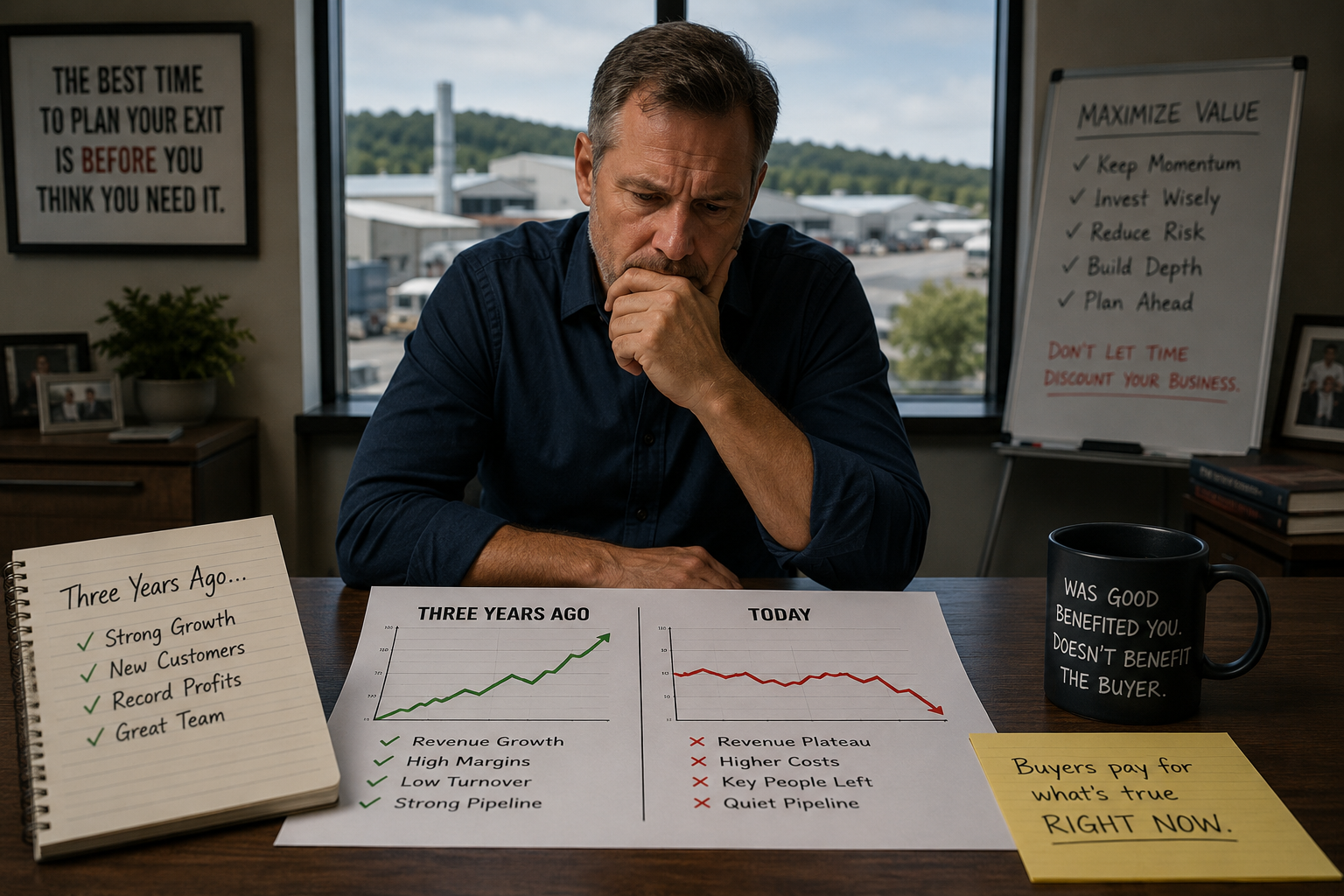
The business was good to you. It was good to your family. That part is real, and no one can take it from you.
But here’s the hard line an owner has to hear before it’s too late to matter: “was good” benefited you. It doesn’t benefit the buyer. When a business isn’t as strong today as it was three years ago, the buyer isn’t interested in paying for what used to be true. They pay for what’s true right now.
I’ve had this conversation more times than I can count. An owner is finally ready to sell, and the business they’re bringing to market is no longer the one buyers would have paid a premium for a few years back. It’s still a real business. They still built something. But the picture has softened — revenue plateaued, a couple of key people left, reinvestment quietly slowed because who wants to pour money into something they’re about to hand off?
It’s still sellable. It would have been worth more, often a lot more, when it still had momentum. And by the time most owners see that clearly, the window to change it has already closed.
The whole point of this piece is to keep that window open. Planning before things change is the pot of gold at the end of the rainbow — and it’s the one part of your exit you still fully control.
Most exits aren’t planned. They’re triggered.
Owners like to believe they’ll pick the perfect moment to sell. In practice, most sales get set in motion by something that was never in the plan: a health scare, a partnership that fractures, a key customer lost, a spouse who’s finished waiting, a competing offer out of nowhere.
Retirement sets its own version of the trap. The business has thrown off strong income for years, so the owner keeps running it — but their engagement quietly fades. They stop chasing new opportunities. They skip the trade shows. They put off the hire. The strategic plan sits in a drawer.
None of that shows up on a tax return right away. But it shows up in momentum. And sophisticated buyers — along with their lenders — are very good at telling the difference between a business that’s still growing and one that’s being held together. Don’t let your own declining energy cost you value while you’re still holding the tiger by the tail.
What waiting actually costs you
The decline rarely arrives in one bad year. It happens in layers.
A sales hire gets delayed. A systems upgrade gets deferred. A competitor starts winning work you’ve stopped fighting for. Key employees feel the drift and start taking recruiter calls. And often the biggest missed investment isn’t equipment or marketing at all — it’s management depth. Owners who wait too long tend to discover they’re still personally holding too many of the important customer, supplier, and employee relationships. That owner-dependence is a risk a buyer can see, and they price it in.
Let me put a real number on it, because this is where it gets expensive. By the time your trailing twelve-month numbers show the damage, buyers may already be discounting your multiple. In some sectors, a business that could have drawn 4x-5x EBITDA during steady growth gets re-priced closer to 3x once revenue stalls, customer concentration tightens, or the owner looks checked out. On a $5 million business, that gap isn’t a rounding error. It’s the difference between a clean exit and a stressful one.
There’s a quieter cost, too. A declining trajectory shrinks your buyer pool. Institutional and PE-backed acquirers in the lower-middle market aren’t shopping for turnarounds — so fading momentum leaves you negotiating with a smaller crowd. That’s exactly the wrong position to be in when you’ve finally decided it’s time.
Selling from strength isn’t about being in a rush
The advice I give owners is not “sell now.” It’s “start thinking seriously about this before you assume you have to.” Those are very different things.
A business selling from strength — growing revenue, high retention, clean books, a management team that doesn’t live or die by the owner — commands a premium. It draws more buyers, creates real competitive tension, and usually closes faster with fewer conditions. The owner has leverage precisely because they don’t need to sell. They’re choosing to.
That leverage starts to vanish the moment the business shows cracks. Buyers sense when an owner is tired, when reinvestment has slowed, when the next chapter is overdue. Desperation is expensive — and it’s the one cost that’s entirely avoidable.
What early planning actually looks like
For most owners, “early” means two to four years before a likely sale. Not because the sale itself takes that long, though preparation does matter, but because that’s when the decisions that shape value are still in front of you instead of behind you.
Starting early gives you a clear read on what your business is actually worth in today’s market — not what you hope it’s worth. It shows you which value drivers matter most to the buyers likely to want a business like yours, where your financials or ownership structure might snag in due diligence, and where the business leans too hard on you personally. It tells you which investments could still lift value before you go to market, and how different deal structures would change your tax, your risk, and what you actually pocket at the end.
None of that commits you to selling a thing. It gives you a clearer picture of your options, and enough runway to act on them on purpose rather than in a scramble.
The best time for this conversation is before you think you need it
If you’ve started picturing life after the business — even as a someday question — that’s the right moment to get an honest read on where you stand. Not because the answer forces your hand, but because knowing changes what’s possible.
Owners who engage early have options. They can strengthen the management team, clean up the financials, reduce customer concentration, sharpen the systems, and make a deliberate call about timing. Owners who wait until circumstances decide for them are usually negotiating from the wrong side of the table.
If selling is even a two-to-four-year question, now is the time to understand what your business might be worth, what buyers would care about, and what you can still improve before you go to market. That conversation doesn’t mean you’re ready to sell. It means you’re still early enough to do something useful with the answer — which is exactly what Preparation to Payday is built to help you do.